Recent Trends and Fundamental Drivers
Venice Token (VVV) has been making waves lately, and it’s not just because of price action. There have been some real structural changes happening with the token that could shape where it goes from here. Back on February 10th, 2026, the team made a pretty significant move by cutting annual emissions from 8 million down to 6 million tokens. That’s a 25% reduction, which basically means less new supply hitting the market and potentially less downward pressure on price over time.
Then there’s the OpenClaw partnership announced in early March 2026. Venice got tapped as a recommended private model provider for their autonomous AI agent platform. What makes this interesting is that staking VVV actually gives you API access, so there’s real utility baked in here. If developers start using this for inference capacity, that could create genuine, sustainable demand beyond just speculation.
But here’s the thing—after a massive rally that saw prices jump nearly 200% in February, the token is looking a bit stretched. The RSI hit around 79 at one point, which is pretty overbought territory. Some pullback wouldn’t be shocking, especially if the broader crypto market cools off. The $5.00 level is looking like an important line in the sand that bulls really need to defend.
So you’ve got this interesting mix of tighter supply, growing real-world use cases, but also momentum that’s maybe gotten ahead of itself. It sets up a classic tug-of-war between those looking to push higher and those expecting a breather.
Key Technical Indicators & Current Price Structure
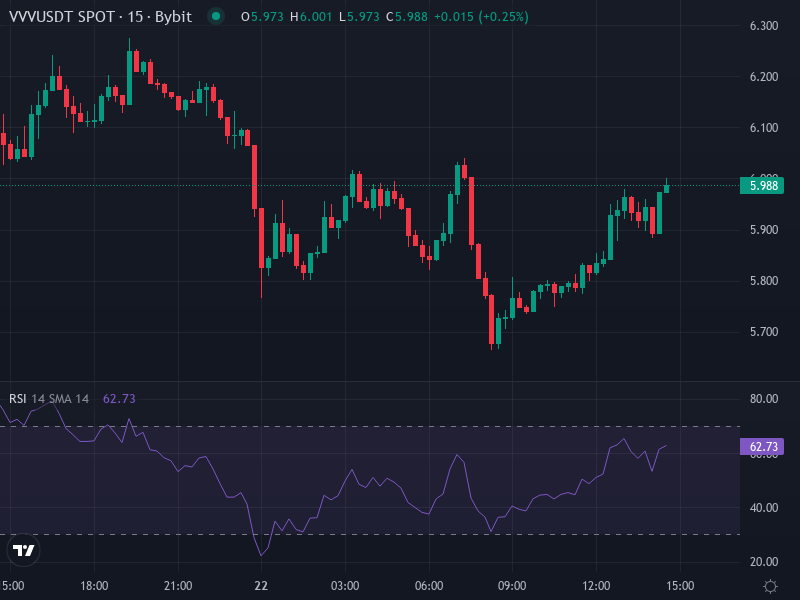
Right now, with VVV sitting around $5.99, the price is comfortably above its major moving averages. The 50-day, 100-day, and shorter-term EMAs are all providing support underneath, which is generally a good sign for the bulls. The 200-day moving average is probably somewhere close below this range, and that often acts as a major trend indicator.
When you look at the oscillators, it’s a bit of a mixed bag. The 14-day RSI seems fairly neutral to slightly bullish, and the MACD just showed a bullish crossover recently, which is positive. On the flip side, shorter timeframe indicators like the Stochastic RSI and Williams %R are flashing overbought warnings, suggesting the rally might be running out of steam in the near term. The ADX shows there’s still trend strength, but the weakness in some supporting indicators hints that conviction isn’t super strong right now.
For support, you’re looking at a cluster around $5.50 to $5.65 where those moving averages sit. If that breaks, stronger support might come in around $5.30 to $5.20. On the resistance side, there’s immediate overhead around $6.20 to $6.50—those nice round numbers where traders often take profits. Beyond that, more substantial resistance sits between $7.50 and $9.00, which lines up with retracements from the all-time high of roughly $22.50.
Short-Term vs Medium-Term Scenarios
Short-Term (Next Few Weeks): Given how overbought things are looking, we’re probably more likely to see some consolidation or even a modest pullback rather than straight-up continuation. A range between $5.30 and $6.20 seems reasonable for the next couple weeks. If we slip below that $5.50 area, sellers might push toward $5.20, and if sentiment really turns sour, even $5.00 could come into play. Any bounce off these support levels could set up another run at that $6.50 resistance. Volume is going to be key here—without fresh buyers stepping in, breaking resistance will be tough.
Medium-Term (1-3 Months): This is where those fundamental improvements really start to matter. The emissions cut and growing API usage provide a solid foundation. If VVV can hold above that $5.20-$5.50 zone and confirm it as support, there’s a decent case for a move toward $8.00 or even higher. If the broader altcoin market catches fire again, we could see a push toward the halfway point from the all-time high, which would put us around $11.00. Of course, there are always wildcards—macro conditions, regulatory news, token unlocks—that could throw a wrench in things.
Raw Price Projection & Risk Outlook
Looking ahead, if things go well, VVV could realistically hit somewhere between $7.50 and $8.50 over the next 6-8 weeks, assuming demand holds up and we can break through that $6.50 resistance. If the whole crypto market gets a tailwind and altcoins really start running, an extension toward $10 or above isn’t out of the question, though that would probably need some serious momentum behind it. On the downside, a drop to around $5.00 to $5.20 seems plausible if we get some profit-taking or negative sentiment. If things get really ugly, we might even see a test of $4.50.
What could go wrong? Well, volume could dry up, making it hard for larger players to move in or out without slippage. Bad news affecting crypto broadly could hit hard. Or we could just see a technical breakdown below those key moving averages that triggers stop losses. On the positive side, new partnerships, actual growth in Venice API usage, or additional token burns or emission cuts could really fuel upside.
Embedded Price Chart
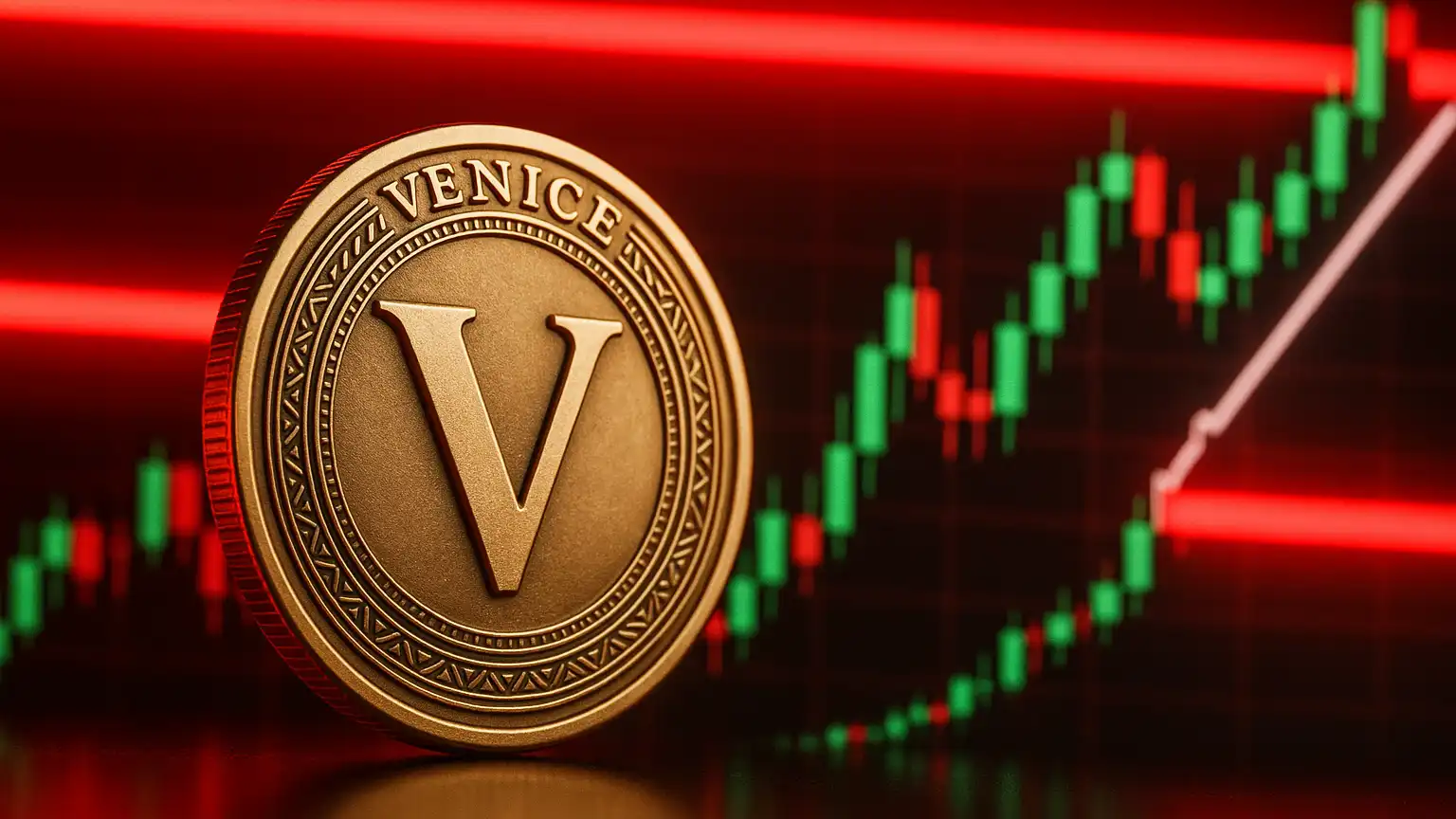
Here’s a look at the recent price action, showing those moving average supports and resistance zones we’ve been talking about.
Final Insight
Venice Token definitely carries some risk, but the fundamentals are starting to look more interesting with that emission cut and the growing ecosystem around it. From a technical standpoint, if we can push through that $6.20-$6.50 resistance with solid volume, a move toward $8.00 to $9.00 starts to look pretty reasonable. That said, with things looking a bit overbought right now, it makes sense to be patient. Those support zones between $5.20 and $5.65 are probably going to be decisive in the next few days and weeks. Smart traders will keep a close eye on these levels, manage their position sizes carefully, and stay ready to react either way. Venice Token is at an interesting crossroads where momentum, utility, and supply dynamics are all converging—how volume responds in the coming days could really set the tone for what comes next.