Recent Developments and Market Context
United Stables has been making some interesting moves lately with the rollout of its $U stablecoin across BNB Smart Chain and Ethereum. What’s caught people’s attention is how they’ve structured the backing—fully 1:1 with actual cash and audited stablecoins like USDC, USDT, and USD1. They’re keeping reserves in segregated accounts and promising quarterly independent audits plus instant on-chain proof-of-reserve, which honestly sounds like they learned from past stablecoin disasters. Right out of the gate, they’ve plugged into some heavy-hitting DeFi protocols—PancakeSwap, Aster, Four.meme, and ListaDAO—and gotten support from wallets people actually use like Binance Wallet, SafePal, and Trust Wallet. HTX has listed it too. What’s particularly intriguing are the features they’re building for AI-driven transactions, like EIP-3009 for gasless transfers and x402-enabled delegated execution. It feels like they’re trying to position $U as the rails for machine-to-machine commerce and autonomous financial agents, which could be huge if that use case actually materializes.
Current Price, Key Technical Indicators, and Near-Term Levels
Right now, $U is trading at roughly 0.99956873 USDT, down about -0.00258534 over the last 24 hours. Since we’re dealing with a stablecoin here, dramatic price swings aren’t really the point—deviations from the dollar peg should naturally correct themselves through arbitrage and the redemption mechanics baked into its design. Let’s break down what matters technically:
- Peg Stability & Price Bands: We’re seeing the price sitting just a hair below the ideal $1.00 mark—about 0.04% off. For stablecoins, anything within ±0.1% is generally fine, but if you start seeing sustained moves below $0.995 or above $1.005, that’s when the market usually steps in to correct things.
- Support and Resistance Zones:
- Support looks solid in the 0.995–1.000 USDT range. This is where arbitrage traders and liquidity hunters typically jump in to push things back toward peg.
- Resistance isn’t really a major factor for stablecoins, but you might see some minor selling pressure if the price climbs above $1.005 as traders arbitrage back to other stablecoins.
- Liquidity and Market Depth: One of the advantages here is that United Stables pools liquidity across USDC, USDT, and USD1, spanning both Ethereum and BNB Chain. This should mean pretty deep liquidity overall. You might see some temporary stress on smaller AMMs that list $U, but the major pools—especially on PancakeSwap for BSC or the big Ethereum DEXs—should handle most trading volume without breaking a sweat.
- Indicators and Volatility: Here’s the thing about analyzing stablecoins—your usual technical indicators like RSI, MACD, or Bollinger Bands don’t tell you much under normal conditions because the whole point is maintaining that peg. Volatility should naturally stay low unless something goes seriously wrong—think depeg risk, regulatory drama, or smart contract vulnerabilities.
Looking at all this together, the realistic expectation for the near term is that United Stables will stay glued pretty close to its peg. Major departures from $1.00 are unlikely unless there’s a shift in market confidence or questions arise about the reserve backing. For active traders, the opportunities are going to be in those very narrow bands—buying when it dips below ~$0.995 or catching slight premiums just above $1.005.
Price Chart Snapshot
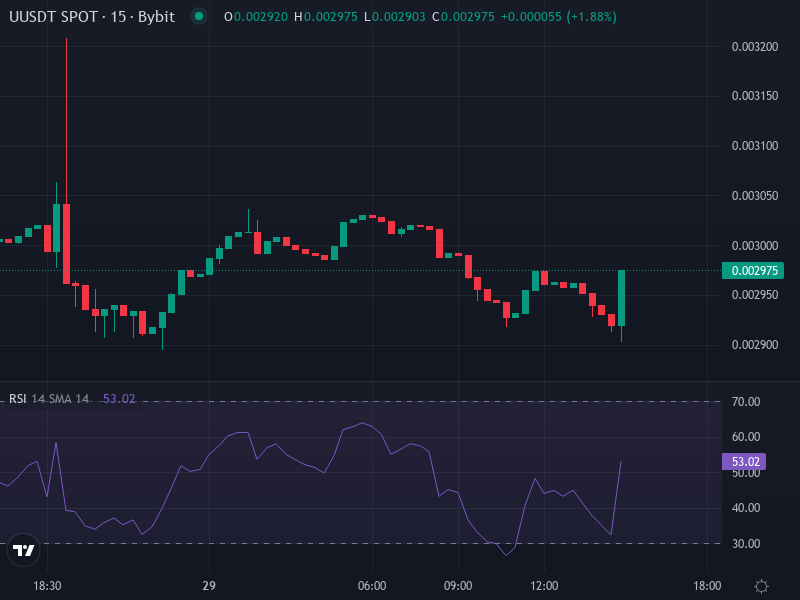
To get a visual sense of what’s been happening, here’s a price chart for $U/USDT showing how it’s been moving relative to its peg and what volumes have looked like:
Granular Insights from the Chart
What you’re seeing in the chart is a pretty tight trading range, mostly between $0.9985 and $1.0015. Volume spikes show up around specific events—new listings, arbitrage activity kicking in—causing brief deviations that quickly snap back to the mean. Importantly, there’s no visible pattern of the peg deteriorating or wandering off over time, which is what you’d want to see if you’re comparing this to some of the messier stablecoin situations from the past.
Technical Price Predictions Under Various Scenarios
While $U isn’t designed for wild price movements, it’s worth mapping out what could happen under different circumstances:
- Baseline Scenario: The peg holds steady at 1:1. You’re looking at a trading range of 0.995 to 1.005 USDT over the next week or two. Minor wobbles within this band with strong gravitational pull back toward $1.00 thanks to arbitrage.
- Positive Trigger (like a major DeFi integration, regulatory green light, or institutional adoption): You might see a slight premium develop, pushing toward ~1.0025–1.005 USDT as demand temporarily outstrips supply in certain pools. Arbitrage will work to level things out, but the price could hang above parity for a bit in venues with thinner liquidity.
- Negative Trigger (concerns about backing, audit problems, or broader stablecoin market panic): Price could slip below $0.995 USDT. If confidence really takes a hit, we might see it drop toward 0.990 USDT in extreme scenarios before major market forces or redemption pressure kicks in to restore the peg.
Long-Term Outlook & Structural Indicators
Looking months down the line, $U’s success isn’t really about price appreciation—it’s about structural soundness:
- Reserve Backing and Audit Integrity: Everything hinges on maintaining that 1:1 reserve ratio with USDC, USDT, and USD1. Those quarterly audits and real-time proof-of-reserve need to be bulletproof. Any hint of problems here and you’ll see peg stress immediately.
- Adoption in AI-Native Use Cases: The real test is whether those planned features—gasless transfers via EIP-3009, delegated execution through x402, and confidential balances—actually get built and adopted. If dApps, enterprises, and AI ecosystems start using this for machine-to-machine payments or microtransactions, you’re looking at genuine demand beyond just arbitrage or speculative flows.
- Cross-Chain Expansion: Right now it’s on Ethereum and BNB Chain, but expanding to other major chains like Polygon, Solana, or Base could significantly boost utility. That said, bridging comes with its own risks, and regulatory clarity across different jurisdictions is going to be critical.
- Regulatory Environment: With governments worldwide scrutinizing stablecoins more closely—especially ones that aggregate liquidity across multiple assets—United Stables will need to stay ahead of compliance requirements. That means transparent KYC, proper reserve disclosures, and balancing privacy features with regulatory expectations.