
Current Trends, Fundamentals & Ecosystem Drivers
Right now, Kamino Finance (KMNO) is trading at around $0.05032, up about 2.68% in the last 24 hours. It’s not a massive pump, but it does show some positive momentum building. What’s really interesting here is what’s happening behind the scenes. Kamino has managed to pull in over $3.6 billion in deposits and controls roughly three-quarters of all lending activity on Solana. That’s a huge piece of the pie. When you consider that Solana’s DeFi space has been growing by more than 30% year-over-year, there’s clearly real demand driving this protocol. The team isn’t just sitting still either—they’re working on some pretty serious features like fixed-rate borrowing, custody-backed collateral, and even real-world asset integrations. These aren’t just buzzwords; they’re moves that could help bridge traditional finance with crypto in a meaningful way.
Key Technical Indicators & Short-Term Signals
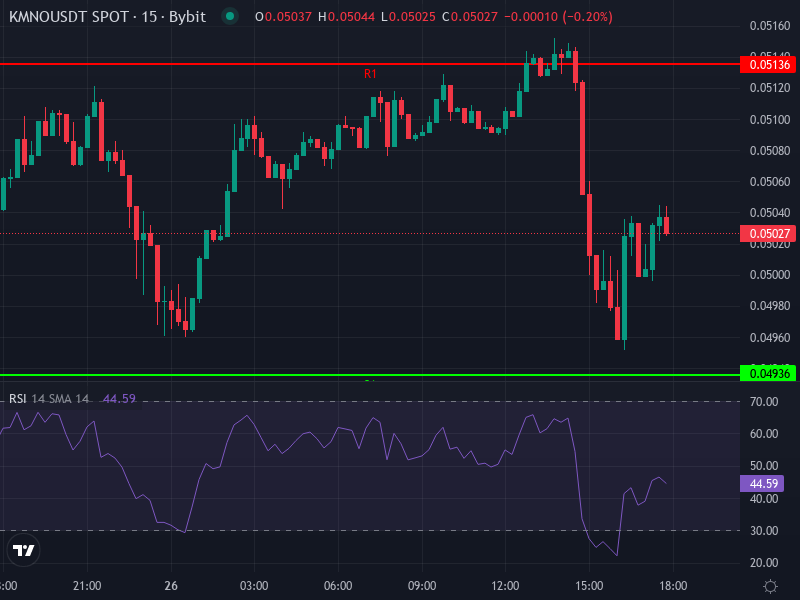
Looking at the 4-hour chart, we can see a few interesting things. The RSI is sitting at about 48.9, which puts it right in the middle—not overbought, not oversold, just kind of neutral territory. The MACD recently crossed bullish, meaning the MACD line moved above the signal line with a positive histogram. That’s typically a sign that some upward momentum might be building in the short term. Price-wise, KMNO is hanging just above its 4-hour simple moving average at around $0.05005, but it’s bumping up against its exponential moving average near $0.05056. So there’s a bit of resistance right there that it needs to push through.
Support, Resistance, and Risk Zones
When we look at the daily pivot points, the main pivot is sitting at about $0.05043. The first real resistance level to watch is around $0.05136, with higher resistance zones ranging from $0.05243 to $0.05336. On the downside, support levels are stacked at $0.04936 and $0.04843, with a stronger floor potentially around $0.04736 if things get choppy. It’s worth noting that some analysts at CoinCodex are forecasting a possible drop to $0.03640 by late January 2026 if bearish conditions take hold. That’s a pretty significant downside scenario, which is why holding those support zones becomes really important.
Price Predictions & Scenarios
When you put the technical setup together with the fundamentals, there are really two main paths forward:
Base Case (Moderate Bullish Continuation)
If KMNO can break cleanly above the $0.0525–$0.0535 resistance zone and actually hold it, we could see buyers step in and push the price toward $0.060–$0.066 over the next several weeks. This scenario assumes the new institutional features start gaining traction and the total value locked keeps climbing. As long as Bitcoin and Solana stay relatively stable or move higher, that momentum could stick around. If things really heat up and it breaks above $0.066, the next target would be somewhere around $0.075.
Bearish Case (Risk & Downside Protection)
On the flip side, if KMNO can’t hold support around $0.0485–$0.0495, things could turn south pretty quickly. The main risks here are large token unlock events or a general cooling off in DeFi sentiment—both have caused problems in the past. If we do see a breakdown, the next logical support area would be somewhere between $0.0425 and $0.0450. Based on some of the more bearish models out there, we could be looking at a 20–25% drop if the broader market sells off or if the protocol hits execution issues.
Outlook & Considerations for Traders & Investors
For anyone actively trading this, keep a close eye on those moving averages on the shorter timeframes—1-hour and 4-hour charts can give you early signals when momentum is shifting. Volume is absolutely critical here. A breakout on weak volume tends to fizzle out pretty fast, so you want to see real conviction behind any move. Token unlock schedules are another wildcard—fresh supply hitting the market can create short-term selling pressure. But on the positive side, if those new features like fixed-rate borrowing and real-world asset support actually launch and gain adoption, especially with institutional money starting to explore Solana, that could be a real catalyst for upside.