
Recent Developments and Market Context
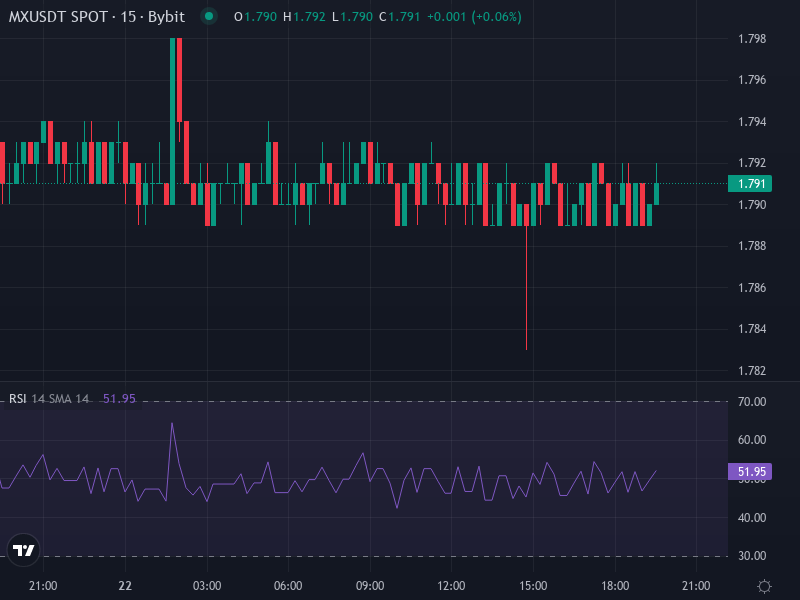
MX Token is currently hovering around $1.7901, down roughly $0.08 over the past 24 hours. Like many altcoins lately, it’s been feeling the squeeze from broader market weakness and dampened investor enthusiasm. That said, MX still has some solid fundamentals working in its favor. As the native token of the MEXC exchange, it offers real utility—think fee discounts, staking rewards, and early access to new token launches and projects. These perks continue to drive genuine demand for the token.
Looking ahead, short-term price predictions are fairly conservative. Most analysts see MX trading in a tight corridor between about $1.79 and $1.92 over the next month, with modest upside possible if key resistance levels give way. The longer-term picture, though, paints a more optimistic story. If market conditions strengthen, MX could climb toward the $5.50 to $6.00 range by the end of 2026, with even more ambitious targets floated for 2030.
Technical Indicators: Support, Resistance & Momentum
Right now, MX is stuck in what traders call a consolidation phase—basically treading water between the 30-day simple moving average around $1.80 and resistance just above at $1.82. Interestingly, the 200-day moving average sits much higher, somewhere around $2.11 or above, which suggests there’s plenty of runway for growth if the token can break out of its current range. The Relative Strength Index is sitting in neutral territory at about 43 to 45, meaning the token isn’t overbought or oversold—it’s just kind of waiting for its next move. Meanwhile, the MACD indicator has recently crossed into bullish territory on some charting platforms, hinting that upward momentum might be building beneath the surface.
On the downside, $1.72 represents an important support level. If MX dips below that, we could see further selling pressure in the near term. On the flip side, breaking cleanly above the $1.80 to $1.82 resistance zone could open the door to a test of $2.05 or even $2.20, depending on how strong the buying interest is. Lose that support, though, and MX might slide toward $1.70 or lower before finding its footing again.
Trading Sentiment and Volatility
The mood around MX in the short term leans bearish, at least according to technical signal summaries. There are more bearish indicators flashing than bullish ones at the moment. That said, volatility for MX has been relatively tame compared to more speculative altcoins, which means we’re unlikely to see dramatic price swings unless there’s some major news—either from MEXC itself or from the broader crypto market.
Forecast Scenarios: Short Term vs Long Term
Short-term outlook (next 1–4 weeks):
Expect MX to continue trading sideways, likely bouncing between $1.75 and $1.85. If buyers can push through that $1.82 resistance with decent volume, we might see a move up toward the $2.00 mark. On the other hand, dropping below $1.75 would signal weakening support and could lead to a retest of the $1.65 to $1.70 area.
Medium term (3–6 months):
If this consolidation phase resolves to the upside and the broader altcoin market catches a tailwind, MX could realistically push into the $2.50 to $3.50 range. What’ll drive that? New features or programs from MEXC, additional token burns that tighten supply, and general strength across the crypto market. In a less favorable scenario, the price might stay pinned below $2.00 and drift back toward $1.50 to $1.70.
Long term (end of 2026 and beyond):
If conditions play out favorably, several analysts think MX could hit $5.50 to $6.50 by late 2026. Looking even further out to 2030, some projections get pretty bullish—$10 or higher isn’t out of the question if MEXC continues to grow and expand the token’s utility. Of course, if macro headwinds persist or the crypto market stalls, MX could remain range-bound and struggle to reclaim its previous highs.
Underlying Strengths and Risk Factors
MX has several things going for it. It’s the native token of MEXC, which means it’s baked into the exchange’s ecosystem. There are deflationary mechanics at play too—MEXC periodically buys back and burns tokens using a portion of exchange profits. Add in the practical benefits like trading fee discounts, staking opportunities, and priority access to new launches, and you’ve got built-in demand that helps cushion downside risk.
That said, MX isn’t without vulnerabilities. It’s highly sensitive to the overall crypto market cycle and regulatory developments. If Bitcoin or Ethereum take a nosedive, MX is likely to follow. The token also faces headwinds from resistance near its long-term moving averages, and without fresh catalysts or announcements from MEXC, investor interest could wane. Supply is still fairly large, so ongoing burns and circulation reductions will be key to shifting the supply-demand balance in holders’ favor.