
Current Market Position & Ecosystem Signals
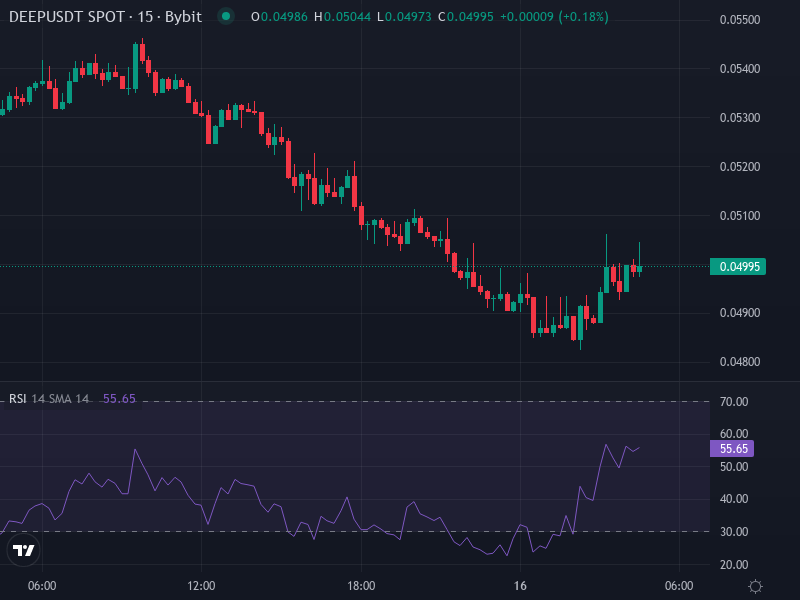
DEEP token is currently hovering around $0.04983 USDT, taking a notable hit with a roughly 6.38% drop over the past 24 hours. This isn’t an isolated event—it’s part of a longer downturn that’s seen the token slide from its early 2025 peak near $0.343. Right now, the market feels pretty cautious. We’re seeing profit-taking, thinner trading volumes, and weak momentum on the upside, all pointing to investors sitting on their hands. That said, DEEP still has solid foundations within the Sui blockchain ecosystem, where it powers liquidity infrastructure through an on-chain centralized orderbook model. There’s institutional backing too—Grayscale’s DEEP Trust shows serious players believe in it, though that confidence hasn’t translated into sustained price gains yet, mainly because we need stronger volume or some exciting new developments.
Let’s talk tokenomics: DEEP has a maximum supply of 10 billion tokens. The circulating supply is still well below that cap, but there’s a gradual unlock schedule ahead that will release more tokens over the coming years, which naturally creates dilution pressure. The token itself is useful—it covers trading fees, governance participation, market maker incentives, and fee discounts for anyone active in Sui’s DeFi space.
Looking at the charts, the near-term picture is getting clearer. Immediate resistance sits around $0.050–$0.052, with tougher barriers at higher moving averages. Support zones are hanging around $0.045–$0.048, and if those break, we could see further downside. Technical indicators are sending mixed signals—short-term momentum is flattening out, but medium-term trends and moving averages still have some grip.
Technical Indicators & Price Prediction Outlook
Diving into the technicals: the RSI isn’t showing overbought conditions, which means DEEP isn’t overheated, but it also means there’s not much buying pressure building up. The MACD is hinting at possible bullish crossovers on shorter timeframes, though these haven’t confirmed on the longer ones yet. Moving averages paint an interesting picture—DEEP is sitting below its 50- and 200-day averages, which isn’t great, but it’s holding above some shorter ones like the 10- or 20-day lines. This suggests short-term downside risk but also the possibility of bouncing back if those support levels hold. The ATR is showing elevated volatility, meaning we’re seeing bigger daily swings lately—that’s risky but also creates opportunities.
Looking ahead to the next few months, there are a few scenarios worth considering. If things go reasonably well—maybe we see more adoption in Sui DeFi, gasless transactions gain traction, margin trading picks up, or staking yields attract attention—DEEP could climb toward $0.070–$0.085 over the next three to six months, assuming volume picks up and those unlock worries ease. If the broader market or Sui ecosystem really delivers some strong signals, breaking past $0.100 isn’t out of the question. On the flip side, if that resistance around $0.050 holds firm and pushes DEEP back down, we might see a retest of $0.040–$0.045, especially with those token unlocks and no fresh catalysts on the horizon.
Key levels worth watching: resistance around $0.051–$0.052, support at $0.048, and a deeper support at $0.045. Breaking through resistance will need real volume behind it, not just quick spikes. The upside stays limited until DEEP can reclaim those longer-term moving averages. Downside risk grows if we see daily closes dropping and staying below short-term supports.
Challenges & Catalysts That Could Tip the Balance
There are definitely some headwinds to be aware of. The token unlock schedule is pretty heavy—most of DEEP’s supply is still locked up, including ecosystem and core contributor allocations. Unless demand really ramps up, those fresh tokens hitting circulation could mean more selling pressure. Competition is fierce too—AMMs and hybrid orderbook models are everywhere in DeFi, so DEEP needs to keep differentiating itself or risk losing ground. And with a relatively modest market cap, any regulatory shocks or broader macro turbulence could amplify volatility.
On the catalyst side, there’s plenty that could shift the momentum positively. Infrastructure upgrades—think improvements in latency, throughput, or those gasless transactions—could be game-changers. Deeper integrations with other Sui projects would help, as would higher Total Value Locked across Sui DeFi, since that means more fee-generating activity. Getting listed on major exchanges would boost accessibility and trading volume. Positive moves from institutions—new trusts, liquidity provision—or meaningful protocol announcements could flip sentiment from consolidation mode to breakout territory. Keeping an eye on these factors should be part of any smart strategy.
Projected Price Bands & Strategy Tips
Putting it all together, here’s what the price action might look like across different timeframes:
- Short-term (1-4 weeks): Expect DEEP to trade between $0.045 and $0.052. Breaking out of this range in either direction will need a volume surge and some supportive news.
- Medium-term (3-6 months): If momentum returns, a reasonable target sits around $0.070–$0.085. If resistance keeps holding, the bearish case keeps it in the $0.040–$0.050 range.
- Long-term (12+ months): If DEEP really becomes Sui’s go-to liquidity layer with strong adoption, solid staking rewards, and healthy fee mechanics, prices above $0.100 become realistic. Without those developments, ongoing dilution could keep it under pressure.
For trading strategies, consider building positions around stronger support levels ($0.045–$0.048), with stops below $0.040 to protect downside. If DEEP breaks above $0.052 with conviction, that could be an entry point for momentum plays—just watch out for false breakouts. Keep tabs on on-chain metrics like daily trading volume, fee earnings, and ecosystem activity, as these often move before the indicators do.