

Introduction & Recent Developments
Aerodrome Finance (AERO), the native token powering the Base-network DEX, wrapped up the last 24 hours trading around $0.3207—down roughly 2.49%. The drop isn’t happening in isolation. We’re seeing similar weakness across altcoins as institutional money pulls back and macro pressures weigh on sentiment. Earlier this year, AERO saw 4-5% slides in similar timeframes, mostly driven by broader market fear and leverage getting flushed out rather than anything specific to the protocol itself.
When you look at what’s actually happening on-chain, the picture gets more interesting. Aerodrome pushed through over $100 billion in platform volume last year—a more than tenfold jump year-over-year. Virtual pair volume rocketed past $8 billion, showing real usage on Base. The protocol commands serious stablecoin volume and has started appearing in institutional DeFi portfolios. But it hasn’t been all smooth sailing. A DNS hijack incident in 2025 spooked people about infrastructure security, and regulatory fog continues to keep AERO off major exchanges and at arm’s length from some institutions.
So we’ve got strong growth numbers bumping up against real concerns—which makes this a pretty pivotal moment for where AERO heads next.
Technical Analysis: Key Levels, Indicators, and Projections
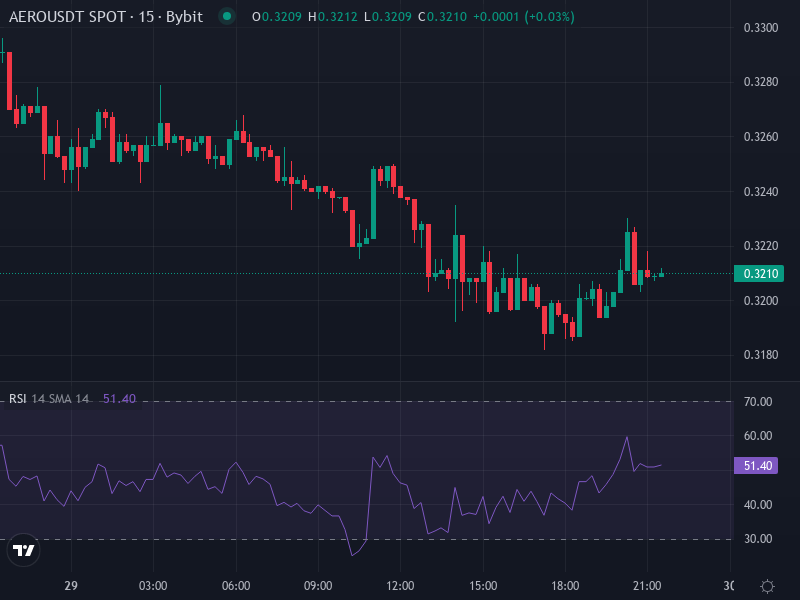
At the current price of around $0.3207, AERO is sitting well below where it’s run into resistance before—that $0.40 to $0.45 zone has been tough to crack. The token looks to be trading under both its 20-day and 200-day moving averages, which paints a bearish picture in both the near and longer term. The RSI seems to have dipped into oversold territory—probably under 30—meaning sellers have been pretty aggressive, but also hinting we might be close to a bounce as bargain hunters step in.
The MACD and ATR readings suggest volatility is still running hot, which makes any sharp recovery feel less certain. If AERO can’t push back above that $0.40 level, we could easily see it test lower support around $0.25 to $0.28, especially if the broader market stays risk-off. Volume is the key thing to watch here—price moves that come with strong volume matter a lot more than quick wicks driven purely by sentiment.
Projected Price Zones: Scenarios for Short-Term (Next 2-4 Weeks)
Bearish scenario: AERO stays capped below $0.35, RSI stays oversold, and crypto markets keep struggling. In this case, we’d likely drift down toward that $0.25 to $0.28 support zone. If that breaks, $0.20 could come into play if liquidity really dries up.
Bullish scenario: If AERO can close above $0.35 on a daily basis—and especially if it clears $0.40—with decent volume behind it, we could see a move back toward $0.50. From there, pushing toward $0.70 to $1.00 would need sustained buying, better regulatory news, and a general return of risk appetite across crypto.
Levels to watch: Resistance around $0.35 to $0.40. Support at $0.25 to $0.28. Breaking through either way will probably set the tone for the next leg.
Risk Factors & Broader Implications
There are several things that could derail even a good-looking technical setup. Regulatory uncertainty is still a big cloud hanging over DeFi protocols, especially ones experimenting with tokenomics that blur the lines between governance and economic rights. Security issues—like that DNS hijack—continue to make conservative investors nervous. And the fact that AERO isn’t listed on major centralized exchanges really limits liquidity and keeps some institutional players on the sidelines, which can amplify downside moves.
That said, Aerodrome has some real strengths. The protocol is generating actual revenue through solid DEX volume and strong stablecoin liquidity, and fees flow back to veAERO holders. That’s genuine yield and protocol alignment—the kind of thing that matters when you’re trying to value DeFi projects more like traditional businesses. If the macro environment shifts and risk appetite comes back, those fundamentals could really stand out.
For anyone looking to trade or invest here, being smart about position sizing and having stop-losses near those support levels is crucial. Keep an eye on the bigger picture too—interest rate decisions, crypto regulation updates, and what major exchanges are doing will matter just as much as what’s happening on-chain.