

Recent Developments & Ecosystem Momentum
Moca Network has been pushing hard on its development roadmap lately, focusing on building out infrastructure for identity verification, credentials, and privacy protection. The team’s working on some interesting product launches, particularly MocaProof—basically a gamified identity verification system that’s currently in beta testing on testnet, with mainnet launch expected sometime in 2026. The idea is to let users prove their credentials privately using zero-knowledge proofs, which is pretty cool tech. If this takes off, it could really drive up demand for MOCA tokens as more people use the network for verification.
They’ve also been busy on the partnership front, teaming up with enterprise platforms like SK Planet and DAT Network. These collaborations are expanding MOCA’s reach into identity-backed advertising, real-world asset finance, and user credentials. The tokens themselves get used for transaction fees, staking, and governance, so there’s actual utility baked in.
On the token supply side, things got a bit messy in early January 2026 when over 275 million tokens (worth roughly $5.95 million at the time) were unlocked ahead of planned upgrades. That’s a lot of new supply hitting the market. The good news is that many strategic partner unlock schedules have been pushed out to January 2027, which should help prevent sudden supply dumps. So you’ve got this tug-of-war happening between growing demand from product launches and partnerships versus the risk of dilution from token unlocks. How the market handles this will really come down to whether the community actually uses these products and whether trading volume picks up.
Technical Price Analysis & Key Indicators
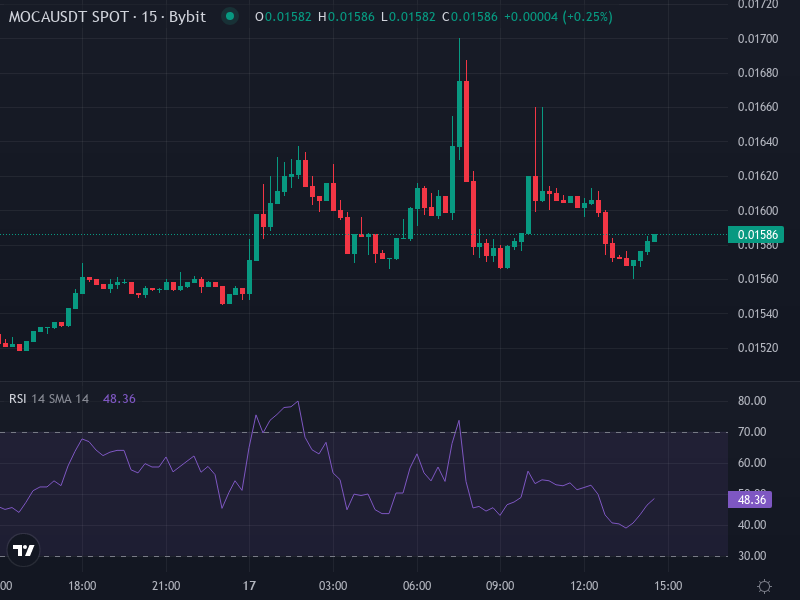
Right now, MOCA/USDT is sitting around $0.01586, up roughly +4.21% over the last 24 hours. Looking at the technical picture, here’s what stands out:
- Trend: The overall trend is bearish, no sugarcoating it. MOCA’s trading below both its 50-day and 200-day moving averages, which tells you the longer-term momentum is negative. The oscillators aren’t showing any strong reversal signals yet either.
- RSI: Daily RSI is hovering around 33-34, getting close to oversold territory. This could set up a short-term bounce if buyers decide to step in.
- MACD & ADX: MACD is slightly negative with no clear crossover happening. ADX is sitting in the medium range around 20-25, meaning the trend isn’t particularly strong in either direction—just kind of drifting downward.
- Support & Resistance Zones:
- Resistance levels: Looking at around $0.020-$0.023. These used to be support areas that are now acting as ceiling. The moving averages in that zone will make it tough to break through.
- Support levels: Key support sits near $0.014-$0.015. If that breaks, we could see a slide down to $0.010-$0.012 depending on how much volume comes in.
- Volatility & Patterns: ATR is elevated at around 10-12%, so expect some wild intraday swings. Price is currently hugging the lower Bollinger Band, which often signals a potential bounce if the selling pressure lets up.
Short-Term vs Medium-Term Scenarios
Scenario A – Bounce from support: If the $0.014-$0.015 support zone holds firm, we could see a decent short-term rally up toward $0.020. If momentum’s really strong, maybe even $0.022-$0.023. This would probably need some kind of catalyst though—good news on MocaProof’s mainnet launch, a major enterprise partnership announcement, or a significant uptick in trading volume.
Scenario B – Breakdown risk: If that support gives way, especially on heavy volume, things could get ugly fast. MOCA might tumble down to $0.010-$0.012. Token unlocks or disappointing usage numbers could be the trigger. A break below recent lows would really intensify the downward pressure.
Volume & Sentiment Indicators: Keep an eye on volume patterns. If volume starts drying up during down moves, that’s actually a sign that selling pressure might be weakening. Bullish reversals usually come with volume spikes. Market sentiment is cautious right now—the technicals are negative but not screaming disaster. Those oversold readings might attract some short covering or speculative buying.
Technical Forecast Summary
Putting it all together, the price outlook for MOCA/USDT over the next few months really hinges on two key zones:
- If things go well, MOCA could retest resistance around $0.020-$0.022, possibly hitting $0.023 if momentum lines up with some good news from institutional partners or ecosystem developments.
- If things go south—whether from token unlocks or weak adoption—MOCA could slide down to $0.010-$0.012 without strong buying support.
The risk-reward setup actually looks decent for cautious buyers near that $0.014-$0.015 support level, but you really need confirmation before jumping in. Wait for volume to pick up, a solid partnership announcement, or positive product news. And definitely use tight stop-losses below that support to protect yourself if things break down. For anyone thinking medium-term, the actual usage metrics—how MocaProof performs, how well those partner integrations work—are going to matter a lot more than short-term chart patterns.
Final Insight
Look, MOCA’s got a compelling story. Web3 identity and credentials are genuinely useful, and they’re making real progress on adoption. But the charts are telling a different story right now—the price is under pressure. If the upcoming token unlocks don’t create a massive supply shock, there’s definitely room for a bounce from these levels. But that resistance overhead around $0.020-$0.023 is going to be tough to crack. Your best bet is to watch how that support holds up, stay tuned to news flow, and see if actual adoption starts matching the hype. Bottom line: this is a high-volatility play. There’s real upside potential here, but only if the team can deliver on their promises and demand actually materializes.